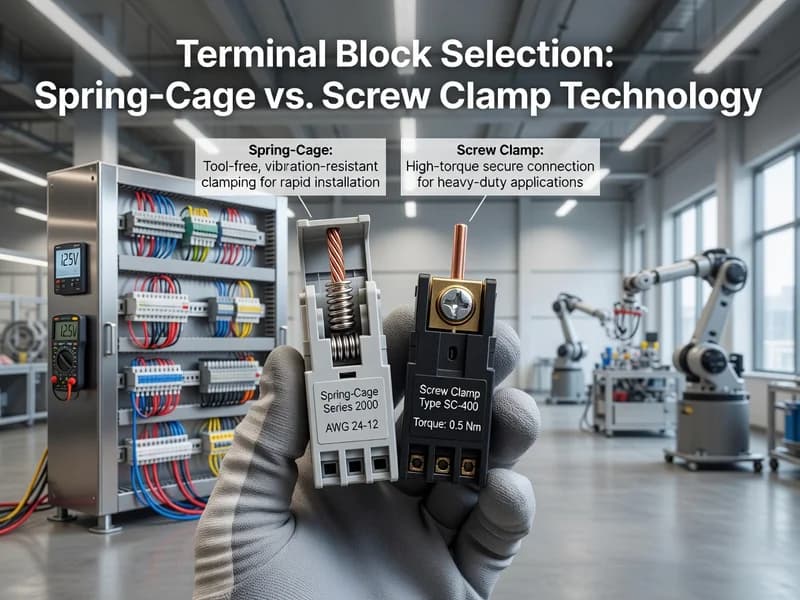
Terminal Block Selection: Spring-Cage vs Screw Clamp Technology
Introduction
Choosing the right terminal block technology is a small decision that can have outsized impact on panel reliability, commissioning time, maintenance workload, and long-term uptime. Two of the most common connection methods for DIN-rail terminal blocks are screw clamp and spring-cage (spring clamp). Both are widely used in industrial control panels, process plants, machine builders, and OEM equipment—and both can meet stringent electrical and safety requirements when correctly specified and installed.
This post compares spring-cage vs screw clamp terminal blocks from a practical, standards-aware perspective, focusing on vibration performance, conductor types, installation practices, and lifecycle considerations relevant to engineers and technicians.
Key Selection Criteria (What Really Drives the Choice)
Before comparing technologies, define the constraints that matter most in your application. The “best” terminal block is often the one that best matches your environment, wiring practices, and maintenance model.
Electrical and mechanical requirements
Consider:
- Conductor size range (e.g., 0.2 to 4 mm², 10 to 24 AWG, etc.)
- Rated voltage/current (depends on block design and standards approvals)
- Short-circuit performance and coordination with protective devices
- Temperature range and derating at elevated ambient temperatures
- Vibration/shock environment (mobile equipment, rotating machinery, presses)
Installation and maintenance requirements
Ask:
- How often will wiring be changed or reworked?
- Is fast termination time a priority?
- Will torque tools be available and used consistently?
- Do you need high repeatability across many technicians/shifts?
Standards and compliance baseline
Terminal block selection is not just “electrical fit”—it’s also compliance with established product and installation standards. Common references include:
- IEC 60947-7-1 (terminal blocks for copper conductors) and IEC 60947-7-2 (protective conductor terminal blocks)
- UL 1059 (terminal blocks; widely used for North American approvals)
- UL 508A (industrial control panels—installation practices, wire sizing, SCCR, etc.)
- IEC 60204-1 (electrical equipment of machines—wiring practices and protective bonding)
- IEC 60364 (low-voltage electrical installations; broader installation rules)
Always verify the terminal block’s approvals and ratings for your specific conductor types (Cu only vs Cu/Al, solid/stranded, ferrule requirements) and intended installation regime (IEC vs UL).
Screw Clamp Terminal Blocks: Strengths, Limitations, and Best Practices
How screw clamp works
A screw clamp terminal block uses a threaded screw to apply clamping force—typically via a pressure plate or clamp yoke—onto the conductor. When correctly tightened to the manufacturer’s torque specification, screw clamp connections can be extremely robust and are familiar to most technicians.
Where screw clamp excels
Screw clamp blocks are often preferred when:
- High conductor pull-out resistance is required and well-documented tightening practices exist.
- Large conductor sizes and higher currents are common (though spring solutions also exist, screw remains prevalent).
- You need visual confirmation of the clamp position and a highly “mechanical” feel.
- The site has established practices for torque-controlled installation.
Common pitfalls (and how to avoid them)
Screw clamp performance is strongly dependent on installation quality:
- Incorrect torque: Under-torque can lead to increased contact resistance and heating; over-torque can damage threads, deform the clamp, or cut strands.
- Thermal cycling relaxation: Copper creep and temperature cycling can reduce clamping force over time if torque is not correct or if re-torque practices are inconsistent.
- Vibration loosening: In high-vibration environments, improperly torqued screws can back off. Many designs mitigate this, but process discipline still matters.
Best practices:
- Use a torque screwdriver set to the manufacturer’s specified value (often listed in the datasheet for each terminal size).
- For fine-stranded conductors, use bootlace ferrules (per manufacturer guidance) for better strand containment and repeatability.
- Follow panel shop standards aligned with UL 508A and/or IEC 60204-1, especially around conductor preparation, routing, and protective bonding.
Spring-Cage (Spring Clamp) Terminal Blocks: Strengths, Limitations, and Best Practices
How spring-cage works
Spring-cage (spring clamp) terminals use a preloaded spring to maintain contact pressure against a current bar. The conductor is inserted directly (in push-in variants) or after opening the spring with an actuator (in spring-cage variants), then the spring applies a consistent force.
Where spring-cage shines
Spring-cage technology is frequently chosen for:
- High vibration and shock environments: The spring maintains contact force despite vibration and thermal cycling—ideal for equipment on moving machinery or near rotating assets.
- Fast, repeatable wiring: Termination time is typically reduced, especially in high-point-count panels.
- Consistent connection quality: Less dependent on technician-applied torque; contact pressure is controlled by the terminal design.
Additional advantages commonly observed in the field:
- Reduced risk of installation variability (no “good feel” tightening guesswork)
- Quick re-termination during troubleshooting and modifications
- Good performance under thermal cycling due to continuous spring force
Considerations and limitations
Spring-cage terminals still require correct application:
- Conductor type compatibility: Many are optimized for solid and stranded copper. Fine-stranded conductors often require ferrules, and push-in types typically require ferrules for smaller, flexible conductors.
- Tool access: Some variants require an actuator tool to open the spring, which can be challenging in very tight wiring ducts.
- Learning curve: Techs accustomed to screw terminals may need brief training on insertion depth, ferrule crimp quality, and release methods.
Best practices:
- Use ferrules sized correctly for the conductor cross-section and insulation collar length.
- Validate conductor strip length to ensure full insertion and minimize exposed copper.
- For maintenance, include a standard “release tool” and labeling to avoid damage from improvised tools.
Practical Comparison: Choosing the Right Terminal for Real-World Panels
Below is a technician- and engineer-friendly decision framework.
Vibration and thermal cycling
- Spring-cage: Generally favored where vibration, shock, or frequent thermal cycling is expected because the spring maintains contact pressure.
- Screw clamp: Works well when torqued correctly and when maintenance practices (inspection/torque verification) are mature.
Installation speed and quality control
- Spring-cage:
- Faster termination, especially at high point counts
- Less rework due to consistent clamping force
- Ideal for production environments seeking repeatability
- Screw clamp:
- Slower due to torqueing
- Quality depends on correct torque tools and workmanship controls
Conductor types and ferrule strategy
- Screw clamp:
- Often tolerant of a wide range of conductors
- Ferrules recommended for fine-stranded conductors to prevent strand splay
- Spring-cage:
- Excellent for solid and stranded; ferrules often required for fine-stranded and for many push-in designs
- Ferrule crimp quality becomes a key variable—use calibrated crimp tools
Maintenance model and troubleshooting
- Spring-cage: Quick remove/replace during troubleshooting; less concern about “did we torque that one?”
- Screw clamp: Familiar for many maintenance teams; however, verification may require torque checks and consistent documentation.
Standards and ratings: what to verify in datasheets
Regardless of technology, confirm the terminal block’s published ratings and approvals:
- IEC ratings (often per IEC 60947-7-1): rated cross-section, rated current, rated voltage, insulation group, creepage/clearance
- UL ratings (commonly per UL 1059): voltage/current ratings and wire ranges under UL conditions
- Temperature limits and any derating curves
- Tightening torque (for screw clamp) and conductor preparation requirements (for both)
- Suitability for protective earth (PE) connections where applicable (see IEC 60947-7-2)
A practical note: IEC and UL ratings may differ for the same physical product due to different test regimes and assumptions. Always design to the rating system relevant to your end market and inspection requirements.
Conclusion
Spring-cage and screw clamp terminal blocks can both deliver safe, compliant, long-lasting connections—when selected and applied correctly. In many industrial panels, the decision comes down to vibration environment, installation repeatability, and maintenance practices:
- Choose spring-cage when you need high vibration resilience, fast wiring, and consistent clamp force without torque dependence.
- Choose screw clamp when your team relies on torque-controlled assembly, you want a highly familiar termination method, or your application and documentation standards are built around screw connections.
For either technology, the most important step is to validate the terminal block against real requirements: conductor types, ferrule policy, ambient temperature, and the applicable compliance framework (IEC 60947-7-x, UL 1059, and installation rules such as UL 508A and IEC 60204-1). That combination—proper selection plus disciplined installation—does more for reliability than any single connector feature ever will.