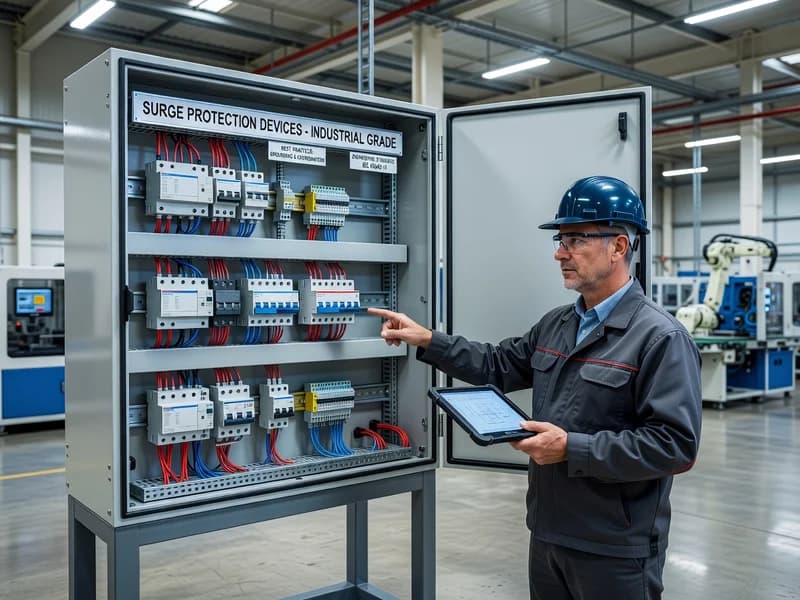
Surge Protection for Industrial Installations: Best Practices
Introduction
Industrial facilities are increasingly vulnerable to transient overvoltage events—short-duration voltage spikes caused by lightning, utility switching, large motor starts/stops, VFDs, welding equipment, and capacitor bank operations. These surges can silently degrade insulation, trip drives and PLCs, corrupt data, and prematurely fail power supplies, instrumentation, and communication interfaces. Effective surge protection is not a single device choice; it’s a coordinated system design that considers the electrical distribution topology, grounding/bonding quality, equipment sensitivity, and applicable standards.
This guide outlines best practices for surge protection in industrial installations, referencing widely used standards such as IEC 61643, IEC 62305, IEEE C62.41/C62.45, and NFPA 70 (NEC) where relevant.
Understanding Surges and Risk in Industrial Power Systems
Surge protection starts with understanding what you’re defending against and where it enters the system.
Common surge sources
- Lightning (direct and indirect):
- Direct strikes to structures or overhead lines can inject very high currents.
- Nearby strikes induce voltages via electromagnetic coupling.
- Utility switching and faults:
- Capacitor bank switching, recloser operations, and feeder transfers.
- Internal switching transients:
- Frequent switching of inductive loads (contactors, solenoids, motors).
- VFDs, soft starters, and rectifier front ends contributing to fast dv/dt events.
- Ground potential rise (GPR):
- Lightning current through the grounding system can elevate local ground reference, stressing signal/ethernet/fieldbus links.
Key standards and concepts to know
- IEC 61643-11: Test methods and classification of SPDs for low-voltage AC power systems (Type 1/2/3).
- IEC 61643-12: Application principles—coordination, selection, and installation practices.
- IEC 62305: Lightning protection system (LPS) risk assessment and design; useful when facilities have external LPS or high lightning exposure.
- IEEE C62.41.1 / C62.41.2: Characterizes typical surge environments (location categories, waveforms).
- IEEE C62.45: Guide on surge testing and measuring SPD effectiveness.
- NEC (NFPA 70):
- Article 285 covers Surge-Protective Devices (SPD) installation for systems ≤1000 V.
- Article 230.67 requires surge protection for dwelling services (not industrial), but Article 285 is broadly applicable for SPD wiring and safety.
- UL 1449 (latest edition): SPD safety standard commonly required in North America; includes Type designations and Voltage Protection Rating (VPR).
SPD Types, Ratings, and Selection Best Practices
Choosing the right SPD means matching the device’s capability to the installation point and surge exposure.
SPD types (IEC and common North American mapping)
- Type 1 (IEC 61643-11): Installed at service entrance or upstream of the main disconnect; intended to handle partial lightning currents. Often specified where an LPS is present or where overhead feeders increase lightning exposure. Tested with 10/350 µs impulse current.
- Type 2: Installed at distribution boards, MCCs, and subpanels; handles switching surges and residual lightning energy. Tested with 8/20 µs current waveform.
- Type 3: Point-of-use protection near sensitive loads (PLC power supplies, instrumentation panels, SCADA nodes). Requires coordination with upstream SPDs.
In UL 1449 terms (common in the U.S./Canada), you’ll see:
- Type 1: Can be installed on line side of service disconnect.
- Type 2: Installed on load side.
- Type 4: Component assemblies (often integrated into equipment).
Critical electrical ratings to specify
When comparing SPDs, prioritize these parameters:
- MCOV (Maximum Continuous Operating Voltage):
- Must exceed system’s highest steady-state voltage (including tolerances). Undersizing MCOV leads to thermal runaway and premature failure.
- Nominal discharge current (In, IEC):
- Indicates the SPD’s endurance under repeated surges (8/20 µs). Higher In generally implies better robustness for industrial duty.
- Maximum discharge current (Imax, IEC) / Surge current rating (often 8/20 µs):
- Peak current the SPD can survive under specified conditions.
- Impulse current (Iimp, IEC Type 1):
- Capability for high-energy lightning current (10/350 µs).
- Voltage protection level (Up, IEC) / VPR (UL 1449):
- A measure of clamping performance. Lower is better—but only meaningful with proper installation lead lengths and coordination.
- SCCR (Short-Circuit Current Rating):
- Must meet or exceed available fault current at the installation point. This is essential in high-fault industrial switchboards and MCCs.
- Modes of protection:
- Typical modes: L-N, L-PE (L-G), N-PE, and L-L depending on system (TN-S, TN-C, TT, IT) and whether neutral is distributed.
Practical selection rules of thumb
- Use a Type 1 SPD at the main service where:
- Facility has an external lightning protection system (IEC 62305),
- Overhead utility service is present,
- High lightning keraunic levels (storm activity) or history of lightning-related outages.
- Use Type 2 SPDs at major downstream distribution points:
- MCC lineups, plant distribution panels, and critical process areas.
- Use Type 3 SPDs for sensitive electronics:
- PLC racks, industrial PCs, power supplies, instrumentation loops.
Installation Best Practices: Placement, Wiring, and Grounding
Even a premium SPD can perform poorly if installed incorrectly. Most real-world failures trace back to wiring inductance, poor bonding, or incorrect connection points.
Place SPDs strategically (cascaded protection)
A coordinated approach reduces let-through voltage at sensitive loads:
- Service entrance (Type 1 or robust Type 2/Type 1-capable per local practice)
- Distribution/MCC level (Type 2)
- Equipment/controls level (Type 3)
IEC 61643-12 emphasizes coordination so that upstream devices absorb the bulk energy, while downstream devices “fine clamp” near sensitive equipment.
Keep leads short and straight
Transient currents rise extremely fast; conductor inductance creates additional voltage drop (V = L·di/dt). Best practices:
- Mount the SPD as close as possible to the busbars or breaker terminals.
- Keep connection conductors:
- Short (minimize length),
- Straight (avoid loops),
- Separated from signal wiring to reduce coupling.
- Use appropriate conductor size per manufacturer instructions; larger cross-section can help but length and routing usually matter more for clamping performance.
Bonding and grounding: make the reference solid
Surge energy must return via a low-impedance path:
- Bond the SPD to the same grounding/bonding network as the protected equipment.
- Ensure bonding jumpers are short and have broad contact area where possible.
- For facilities with external lightning protection (LPS), confirm proper bonding between:
- LPS down conductors,
- Building steel,
- Main earthing terminal (MET),
- Service ground and equipotential bonding network
per IEC 62305 practices.
Overcurrent protection and disconnects
- Follow NEC Article 285 and manufacturer guidance on required overcurrent protection (OCPD).
- Some SPDs include internal disconnects; others require a dedicated breaker or fuses.
- Verify coordination with upstream protective devices to prevent nuisance trips while ensuring safe isolation under end-of-life conditions.
Protecting Data, Control, and Instrumentation Circuits
Industrial downtime is often caused not by power damage but by failed I/O cards, burned comm ports, or intermittent sensor behavior after transient events.
Protect more than the power feeder
In addition to AC mains SPDs, consider protection for:
- Ethernet (Industrial Ethernet), serial links (RS-485/RS-232), and fieldbus
- 4–20 mA and analog inputs
- Discrete I/O lines leaving a control panel
- Instrumentation in outdoor/remote areas (tank farms, conveyors, pumping stations)
Use SPDs designed and listed for the signal type and bandwidth. Key selection parameters:
- Clamping voltage vs. signal levels (avoid affecting normal operation)
- Insertion loss / bandwidth for high-speed data
- Shield termination strategy (single-ended vs. both ends depends on EMC and grounding design)
- Surge test waveforms appropriate to the interface (manufacturers often reference IEC test methods)
Panel-level wiring practices (often overlooked)
- Maintain physical separation between:
- high-energy surge diversion paths and low-level I/O wiring,
- power conductors and communication cables.
- Use proper cable shielding and grounding at defined points.
- Route surge-protected interfaces so the protected side goes directly to the equipment, not back through long internal wiring runs.
Verification, Maintenance, and Documentation
SPDs are not “install and forget”—especially in harsh electrical environments.
Commissioning checks
- Confirm system grounding type (TN-S/TN-C/TT/IT) and SPD modes match.
- Verify torque, conductor routing, and shortest-possible installation.
- Check available fault current vs. SPD SCCR.
- Record baseline indicators:
- status lights,
- dry contacts to SCADA/PLC,
- any monitoring module readings if provided.
Maintenance best practices
- Inspect SPDs after major electrical events (utility faults, lightning storms, major equipment failures).
- Periodically verify:
- indicator status (green/red),
- alarm contacts operation,
- thermal disconnect health (if accessible),
- panel cleanliness and tightening schedule (as appropriate for vibration/thermal cycling).
- Replace modules or devices per manufacturer end-of-life indications—MOV-based SPDs degrade with cumulative exposure.
Documentation engineers appreciate
Include in your electrical files:
- One-line diagrams showing SPD locations and type
- Make/model, ratings (MCOV, In/Imax, Iimp, Up/VPR, SCCR)
- OCPD details and breaker/fuse identifiers
- Grounding/bonding drawings and installation photos
- Maintenance interval and spare parts list (plug-in modules, fuses)
Conclusion
Best-practice surge protection for industrial installations is a coordinated system: robust Type 1/Type 2 protection at service and distribution, Type 3 at sensitive loads, and comprehensive protection for control and communication circuits. Selection should be grounded in real ratings—MCOV, In/Imax/Iimp, Up/VPR, SCCR—and aligned with established guidance from IEC 61643, IEC 62305, IEEE C62.41, UL 1449, and NEC Article 285. Finally, installation details—short leads, correct bonding, and proper OCPD—often determine whether the SPD performs as designed.
If you treat surge protection as part of your facility’s reliability program (design, verify, monitor, and maintain), you’ll dramatically reduce unexplained electronics failures and improve uptime where it matters most: at the process.