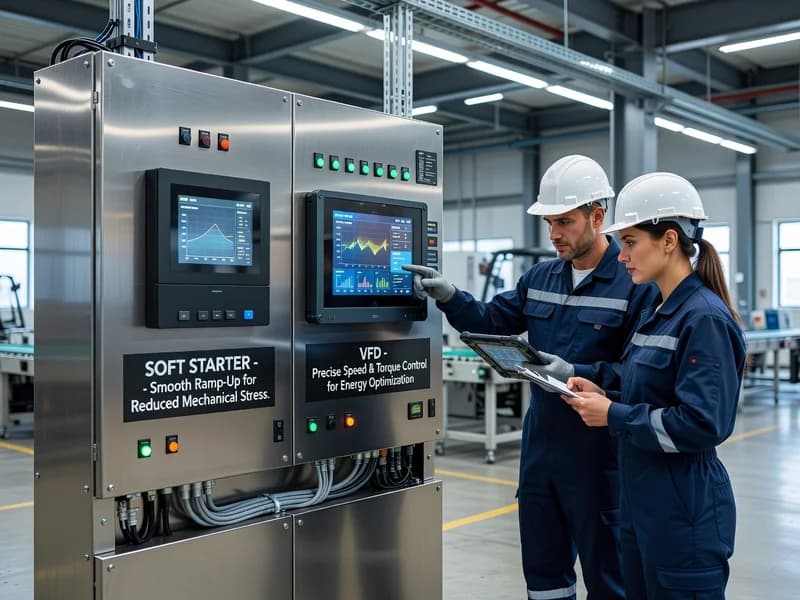
Soft Starter vs VFD: Making the Right Choice for Motor Starting
Introduction
Choosing between a soft starter and a variable frequency drive (VFD) is one of the most common decisions in industrial motor control. Both reduce electrical and mechanical stress compared with across-the-line starting, but they solve different problems. A soft starter primarily manages starting (and sometimes stopping) by reducing inrush current and torque shock. A VFD controls speed and torque continuously by changing motor frequency and voltage.
For engineers and technicians, the “right” choice depends on load type, required control, power quality, protection needs, environment, and lifecycle cost. This guide compares soft starters vs VFDs with practical selection guidance and references to widely used standards (IEC and NEMA).
Soft Starter vs VFD: What They Do (and How They Work)
Soft starters: reduced-voltage starting with SCRs
A soft starter uses thyristors (SCRs) to reduce the RMS voltage applied to an AC induction motor during start. By ramping voltage up over time (or limiting current), it reduces:
- Locked-rotor/inrush current
- Mechanical shock to couplings, belts, gearboxes
- Voltage dip on the upstream system
Most soft starters include:
- Adjustable voltage ramp or current limit
- Kick start (brief boost to overcome stiction)
- Soft stop (useful for pumps to reduce water hammer)
- Built-in overload functions (model-dependent)
Key point: After the motor reaches speed, many soft starters bypass the SCRs using an internal bypass contactor to reduce losses and heating.
VFDs: true variable speed control
A VFD (adjustable speed drive) rectifies AC to DC, filters it in a DC bus, then inverts it back to a variable-frequency, variable-voltage output using PWM (typically IGBTs). This enables:
- Speed control (Hz control = RPM control for induction motors)
- Torque control across a wide operating range
- Controlled acceleration/deceleration
- Energy savings on variable-torque loads (fans/pumps) via affinity laws
Key point: A VFD is not just a “starter”—it’s a continuous motor controller.
Relevant standards and specifications
When comparing products and designing systems, these standards commonly apply:
- IEC 60947-4-2: AC semiconductor motor controllers and starters (soft starters)
- IEC 61800 series (notably IEC 61800-2/3/5-1): Adjustable speed electrical power drive systems (VFD performance, EMC, safety)
- NEMA ICS 7.1: Adjustable-speed drives (common in North America)
- UL 508C: Power conversion equipment (VFDs and some solid-state motor controllers in UL systems)
- IEEE 519: Harmonic control in power systems (relevant especially for VFD front-end harmonics)
Performance Comparison: Starting, Running, Energy, and Power Quality
Starting current and torque behavior
Both devices can reduce inrush current, but their torque profiles differ:
-
Soft starter
- Reduces voltage → torque roughly proportional to V²
- Excellent for limiting current and smoothing mechanical engagement
- Not ideal when high starting torque is required at low speed for long durations (heating risk)
-
VFD
- Controls frequency and voltage together (e.g., V/Hz) → can maintain torque at low speed
- Better for heavy starts, high-inertia loads, and applications needing controlled acceleration under load
- Can provide torque boost, DC braking, and sophisticated control (sensorless vector, closed-loop vector)
Speed control and process control
Ask one question: Do you need speed control after the motor is running?
- If no (motor runs at line speed): soft starter is often the simplest solution.
- If yes (variable flow, pressure, tension, or throughput): a VFD is usually the correct tool.
Energy consumption and operating cost
This is where VFDs often justify their higher initial cost:
-
Fans and centrifugal pumps (variable torque)
VFDs can reduce speed to match demand. Because power varies roughly with the cube of speed, even modest speed reduction can yield large savings. -
Constant-torque loads (conveyors, positive displacement pumps, compressors)
Energy savings may be limited unless the process truly benefits from reduced speed. Soft starters generally don’t change steady-state energy use; they mainly reduce start stress.
Power quality: harmonics, EMC, and voltage drop
-
Soft starter
- Harmonics occur mainly during starting (SCR phase-angle control)
- Once bypassed, harmonic contribution is minimal
- Often easier on EMC than a VFD (but still consider line reactors and wiring practices)
-
VFD
- Creates continuous input current harmonics (typically 6-pulse rectifier) and output dv/dt
- May require:
- Line reactors or DC chokes (to reduce input harmonics/peak currents)
- EMC/RFI filters (for conducted emissions per IEC 61800-3)
- Output reactors or dv/dt filters, especially with long motor leads to mitigate insulation stress and bearing currents
For facilities with strict harmonic limits, consult IEEE 519 at the point of common coupling and consider 12/18-pulse, active front end, or harmonic filters if needed.
Practical Selection Guide by Application
Choose a soft starter when:
Soft starters are often the best fit when you need gentler starts but don’t need speed control.
Common applications:
- Pumps (especially with soft stop to reduce water hammer)
- Fans/blowers with fixed-speed operation
- Compressors (when fixed speed is acceptable and start is the main concern)
- Conveyors where ramped starting reduces belt shock (but speed remains fixed)
Practical benefits:
- Lower cost and simpler commissioning vs VFD
- Reduced mechanical stress during start
- Lower losses in steady-state with bypass contactor
Watch-outs:
- Limited low-speed torque capability (voltage reduction reduces torque quickly)
- Not a solution for process flow control—valves/dampers still do the throttling
- Starting time must be managed to avoid motor overheating (check motor thermal limits)
Choose a VFD when:
A VFD is typically the right choice if the process demands control beyond starting.
Common applications:
- Variable flow/pressure pumping systems (replace throttling control)
- Fans with airflow control via speed
- Conveyors needing speed matching, soft indexing, or controlled stopping
- Mixers/extruders requiring torque control across a speed range
- High-inertia loads needing controlled accel/decel or braking control
Practical benefits:
- Speed control + soft start/stop in one device
- Better low-speed torque performance
- Process optimization and potential energy savings
Watch-outs:
- More complex wiring, parameters, and troubleshooting
- EMC and harmonics must be managed (IEC 61800-3 environment categories, IEEE 519 compliance)
- Motor considerations: insulation system, cooling at low speed, and bearing currents
- For older motors, consider inverter-duty ratings (often aligned with NEMA MG 1 Part 31 guidance in North America)
Engineering Considerations: Sizing, Protection, and Installation
Sizing rules of thumb (always verify datasheets)
-
Soft starter sizing
- Base it on motor FLA and duty (number of starts/hour), start time, and load inertia
- Heavy-duty starts may require oversizing the soft starter frame
- Confirm whether the unit is in-line or inside-delta rated (inside-delta can reduce required current rating but changes wiring and protection approach)
-
VFD sizing
- Consider continuous current, overload rating (e.g., 110%/60s or 150%/60s), and load type (variable torque vs constant torque)
- Check ambient temperature derating, altitude derating, and enclosure thermal limits
- Confirm carrier frequency impacts on derating and motor heating
Protection and coordination
- Soft starters and VFDs are not drop-in replacements for a contactor alone. Verify:
- Short-circuit protection device (SCPD) type and ratings (fuses/MCCB) per manufacturer instructions and applicable standards (UL/IEC system)
- Overload protection method:
- Soft starter may include electronic overload (or may require external overload relay)
- VFD typically provides motor overload models, but settings must match motor nameplate and cooling conditions
- Bypass contactor requirements (soft starter) and whether it’s internal or external
Cabling, grounding, and motor lead length (VFD-specific)
For VFD installations:
- Use proper grounding and shielded motor cable where required by EMC plans.
- Manage motor lead length; long cables can increase reflected wave overvoltage and dv/dt stress.
- Consider dv/dt filters or sine filters for long runs or sensitive motors.
Conclusion
A soft starter is the best choice when you need to reduce inrush current and mechanical stress during starting (and possibly soften stopping) while running at full line speed. It’s cost-effective, simpler to commission, and—when bypassed—adds minimal steady-state losses and harmonics.
A VFD is the best choice when you need speed control, improved low-speed torque, controlled deceleration/braking, or significant energy savings on variable-torque loads like pumps and fans. It requires more attention to harmonics, EMC (IEC 61800-3), cabling, and motor suitability, but it unlocks process control benefits that a soft starter cannot provide.
For most facilities, the decision comes down to one practical question: Is this a “start/stop stress” problem (soft starter), or a “speed/process control” problem (VFD)? If you answer that clearly—and validate with standards-based power quality and protection requirements—you’ll consistently select the right solution.