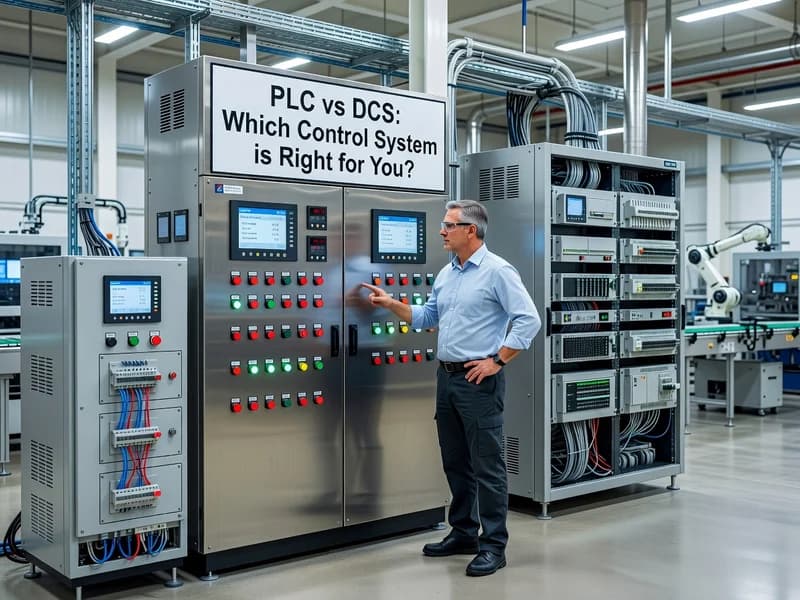
PLC vs DCS: Which Control System is Right for You?
Introduction
Choosing between a Programmable Logic Controller (PLC) and a Distributed Control System (DCS) is one of the most consequential decisions in industrial automation. Both can run PID loops, interface with I/O, communicate over industrial networks, and integrate with SCADA/HMI—but they are optimized for different plant realities: discrete vs. continuous processes, machine-level vs. plant-level control, and “fast and deterministic” vs. “highly integrated and standardized.”
This guide explains practical differences, typical architectures, and selection criteria you can use on real projects. It also references widely used standards (IEC 61131-3, IEC 61511, IEC 62443, IEC 61850, etc.) to help you align the choice with safety, cybersecurity, and maintainability requirements.
PLC vs DCS: What They Are (and How They’re Typically Used)
PLC in a nutshell
A PLC is an industrial controller designed for high-speed, deterministic control—especially for discrete and sequential logic. PLC platforms are common in:
- Packaging lines and material handling
- Machine control (interlocks, sequencing, motion)
- Batch skids and OEM equipment
- Remote I/O panels and distributed machines
Programming standard: Most PLCs support IEC 61131-3 languages such as Ladder Diagram (LD), Function Block Diagram (FBD), Structured Text (ST), and Sequential Function Chart (SFC).
Core strengths:
- Fast scan times and strong discrete logic handling
- Excellent modularity for machine-level control
- Broad vendor ecosystem and cost-effective scaling for smaller systems
DCS in a nutshell
A DCS is designed for continuous and hybrid process control with a focus on plant-wide integration: controller + I/O + engineering tools + historian + alarms + operator graphics working as a cohesive suite. DCS platforms are common in:
- Refining and petrochemical
- Power generation balance-of-plant
- Pulp and paper
- Large water/wastewater plants
- Minerals processing and large utilities
Core strengths:
- Integrated operations environment (alarm mgmt, historian, graphics, control strategies)
- High availability options and lifecycle support for long-lived plants
- Strong process-centric engineering workflows (loop management, faceplates, libraries)
Practical reality: modern PLC + SCADA/PAS (process automation system) stacks can resemble a DCS in capability. The difference is often integration depth, engineering consistency, and lifecycle approach—not just “can it do PID?”
Architecture and Performance: Control, I/O, Networks, and Redundancy
Control execution and determinism
- PLCs are often chosen where deterministic response is critical: high-speed discrete events, interlocks, and motion. Scan-based execution is common, with task scheduling and interrupt handling for time-critical events.
- DCS controllers prioritize stable, predictable process control execution across many loops, with integrated function blocks and standardized loop handling. They can be very deterministic as well, but the engineering model emphasizes process loops, alarms, and operator interaction at scale.
I/O strategy and plant layout
Both systems support local and remote I/O, but the “default design philosophy” differs:
- PLC systems frequently use distributed remote I/O (EtherNet/IP, PROFINET, Modbus TCP, etc.) optimized for machine cells, skids, and modular equipment.
- DCS systems commonly standardize on DCS-native remote I/O families, with strong support for marshalling, loop diagnostics, and standardized signal handling.
For substation and power automation environments, IEC 61850 (GOOSE, MMS) may influence the decision—especially if integration with protection relays and bay controllers is required.
Redundancy and availability
Both can be engineered for high availability, but DCS platforms typically offer it as a core, standardized feature set:
- PLC redundancy: may involve redundant CPUs, redundant power supplies, ring topologies, redundant networks—often engineered and validated case-by-case.
- DCS redundancy: commonly includes standardized options for controller redundancy, redundant I/O, redundant servers, and redundant operator stations, with built-in diagnostics and switchover behavior aligned to process control expectations.
Tip: If your process cannot tolerate a controller reboot or requires predictable failover behavior, compare vendor redundancy specifications (switchover time, bumpless transfer of PID, state retention, and alarm/event behavior).
Engineering, Operations, and Lifecycle: What Matters After Startup
Configuration workflows and libraries
- PLC projects often rely on engineer-developed standards (UDTs, AOIs, function blocks), reusable libraries, and disciplined version control. Success depends heavily on the integrator’s architecture.
- DCS projects generally provide a unified engineering environment with built-in object models (loops, faceplates, alarm templates), making it easier to enforce plant-wide standards.
This becomes important for large sites where many engineers and technicians maintain the system over decades.
Alarm management and operator effectiveness
Alarm performance is frequently the difference between “running” and “running safely.” DCS platforms typically provide mature, integrated alarm tools aligned with ISA-18.2 (and IEC 62682, the international counterpart), including:
- Alarm rationalization support
- Shelving/suppression workflows
- Alarm priority and state-based alarming
PLC + SCADA systems can meet these goals too, but it may require careful SCADA selection and significant engineering discipline.
Change management and documentation
In regulated or high-risk environments, changes must be controlled and traceable:
- Consider how each platform supports audit trails, electronic records, and systematic testing.
- For safety-related systems, your process will often be guided by IEC 61511 (functional safety for the process industry). Even if the basic control system (BPCS) is not the safety instrumented system (SIS), IEC 61511 strongly influences documentation, management of change, and proof testing culture.
Field note: Many plants use PLCs for the SIS (via TÜV-certified safety PLCs) and DCS for BPCS—or PLC + SCADA for BPCS. The key is clear segregation and compliance with the safety lifecycle.
How to Choose: Practical Selection Criteria (With Real-World Examples)
Choose a PLC-based system when…
A PLC is often the best fit when your project is machine-centric or modular and demands fast logic execution.
Good PLC candidates:
- High-speed discrete manufacturing (conveyors, packaging, assembly)
- OEM skids (compressor packages, dosing skids, burner management auxiliaries where allowed)
- Motion-heavy applications (coordinated drives/servo)
- Sites that prefer multi-vendor flexibility and incremental expansion
Checklist:
- Do you need sub-10 ms task execution for critical interlocks or motion coordination?
- Is the system naturally divided into many independent machines or skids?
- Are you comfortable engineering (and maintaining) a consistent alarm/graphics standard in SCADA?
Choose a DCS when…
A DCS is often the best fit for large continuous or hybrid processes where operator effectiveness, integrated alarms, historian, and long-term standardization are essential.
Good DCS candidates:
- Refining, chemicals, and large utilities with thousands of I/O
- Plants with heavy emphasis on console operations and alarm management
- High availability requirements with standardized redundancy
- Long lifecycle projects where vendor roadmap and support matter
Checklist:
- Do you have hundreds to thousands of PID loops and complex unit operations?
- Will multiple units need consistent faceplates, alarms, and operating philosophy?
- Is standardized redundancy and centralized asset management a requirement?
Consider a hybrid approach
Many modern plants implement a layered architecture:
- PLC at the edge for machine control, fast interlocks, and packaged equipment
- DCS or SCADA/PAS at the plant level for supervisory control, historian, alarms, and reporting
This can reduce risk and cost, but make sure responsibilities are clear (who owns permissives, shutdown logic, alarm philosophy, and cybersecurity controls).
Don’t ignore cybersecurity and network zoning
Regardless of PLC or DCS, align your design with IEC 62443 (industrial cybersecurity). Key practices include:
- Segmentation into zones and conduits (control, safety, DMZ, enterprise)
- Managed switches, firewalling, and controlled remote access
- Patch management and backup/restore procedures
- Secure-by-design vendor features (role-based access control, logging)
In many projects, the chosen platform is less important than whether the architecture and governance meet IEC 62443 expectations.
Conclusion
PLC and DCS platforms both deliver industrial-grade control—but they optimize for different outcomes. PLC systems excel in deterministic, modular machine control and cost-effective scaling, while DCS platforms shine in integrated plant-wide operations, standardized engineering, robust alarm management, and long-term lifecycle consistency.
To decide, map your process needs (discrete vs. continuous), operational model (machine techs vs. control room operators), availability requirements, and compliance drivers (IEC 61131-3, IEC 61511, ISA-18.2/IEC 62682, IEC 62443). If your plant includes both machine skids and continuous process units, a hybrid architecture is often the most practical—and most maintainable—solution.
If you’re specifying components (I/O, power supplies, networking, enclosures, relays, industrial PCs), build your bill of materials around the architecture you choose: redundancy, environmental ratings, network topology, and cybersecurity controls should be designed in from the start—not bolted on after commissioning.