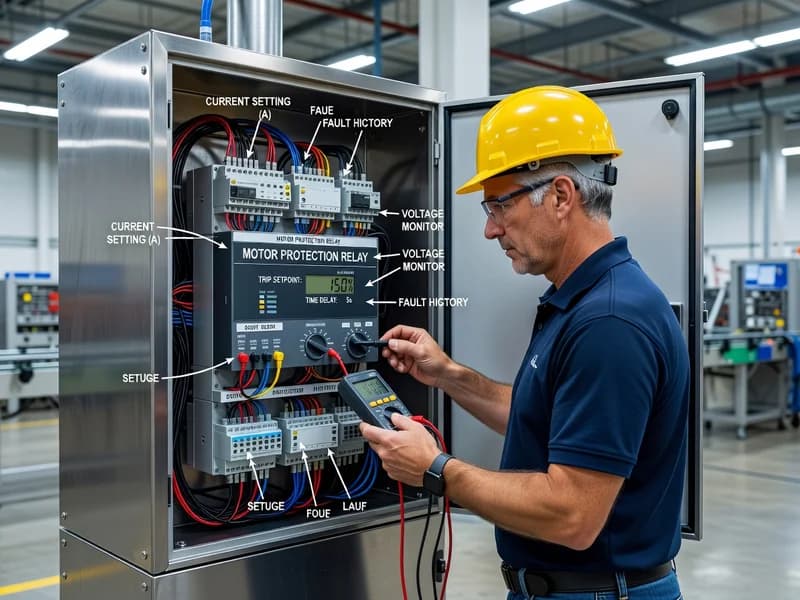
How to Set Motor Protection Relay Parameters Correctly
Introduction
Motor protection relays are only as effective as the settings programmed into them. Too conservative and you’ll nuisance-trip on every start or load change; too permissive and you risk insulation damage, rotor heating, bearing failure, or catastrophic winding faults. Correct parameterization requires more than copying nameplate amps—it means aligning relay functions with the motor’s thermal capability, starting method, duty cycle, and the upstream/downstream protection scheme.
This guide explains a practical, standards-informed workflow to set motor protection relay parameters correctly for common industrial induction motors (across-the-line, star-delta, soft starter, and VFD applications). It references widely used standards such as IEC 60947-4-1 (contactors and motor-starters), IEC 60255 (measuring relays and protection equipment), and common motor data per IEC 60034 / NEMA MG 1.
Gather the Right Data Before You Touch Settings
Correct settings start with correct inputs. Collect these items and document them in a commissioning sheet:
Motor and application data
- Rated voltage, frequency, rated power, full-load current (FLC) (nameplate)
- Service factor (often NEMA; IEC motors may not list SF)
- Insulation class & temperature rise (IEC 60034 or NEMA MG 1 context)
- Locked-rotor current (LRA) / starting current and starting time (datasheet, test, or drive/soft starter logs)
- Duty cycle / starts per hour and typical load profile
- Cooling method (TEFC, forced ventilation, separately driven fan), and whether airflow is reduced at low speed (VFD)
Power system and installation data
- Starting method: DOL, star-delta, autotransformer, soft starter, VFD
- CT ratio and class (if external CTs are used), wiring (residual/CBCT for earth fault)
- Cable length and type (affects leakage and earth-fault measurement sensitivity)
- Coordination with upstream protection: MCCB/ACB, fuses, feeder relay, transformer protection
- Motor feeder layout: number of conductors through CT, grounding method, presence of neutral
Practical tip: If you don’t know the actual start time and start current, measure them. Many “mystery trips” come from assuming typical values instead of recording real ones.
Set Core Current and Thermal Protection Parameters
This is the foundation of motor protection. Most modern relays implement a thermal model (I²t) to approximate winding temperature. Parameters differ by manufacturer, but the concepts are consistent.
1) Set the motor rated current (Ir / In / FLA)
- Enter the motor nameplate FLC as the relay’s rated current reference.
- Verify the relay’s current input matches the measurement chain:
- If using CTs: confirm CT primary/secondary and relay expects 1 A or 5 A input.
- Confirm correct phase mapping and polarity.
Common mistake: entering motor FLC while forgetting the relay is reading CT secondary amps—leading to settings off by the CT ratio.
2) Overload pickup (thermal)
For IEC-style overload protection, a common target is:
- Overload pickup ≈ 1.00 to 1.05 × FLC for continuous-duty motors at normal ambient
- If the motor is allowed to run into service factor (common in some NEMA applications), you may allow higher—but only if the motor and process justify it.
Standards context: IEC 60947-4-1 defines trip classes and performance expectations for overload relays. For electronic relays, the thermal model aims to protect windings similarly, but you must still align settings with real start and load conditions.
3) Select the trip class (Class 10A/10/20/30)
Trip class primarily affects how long the relay tolerates elevated current during starting before tripping. Typical guidance:
- Class 10/10A: normal starts, low inertia, short acceleration
- Class 20: longer starts, moderate inertia (fans, some conveyors)
- Class 30: very long starts / high inertia (large crushers, high-inertia loads)
How to choose (practical):
- Determine the maximum starting time under worst-case conditions (low voltage, high load, hot motor).
- Choose a class that allows that start time with margin but still trips on a stalled rotor quickly enough to prevent damage.
4) Thermal capacity and cooling settings
Many relays allow configuration of:
- Thermal capacity used (TCU) / thermal state memory
- Cooling time constant (hot/cold curves), and whether to “remember” temperature after power loss
Recommendations:
- Enable thermal memory so the motor is protected after short outages or repeated starts.
- Set cooling behavior consistent with reality:
- Self-ventilated motor on VFD at low speed cools poorly; consider more conservative thermal settings and/or use motor PTC/RTD inputs if available.
Configure Starting, Stall, and Jam Protection Without Nuisance Trips
Starting events stress motors and cause most false trips. Set start-related elements deliberately.
1) Start current and start time supervision
If the relay has a start/acceleration supervision function:
- Set Start Current Threshold slightly above typical running current (so it recognizes a start), often ~1.5 × FLC.
- Set Max Start Time based on measured start time plus margin (commonly +20–30%).
For each starting method:
- DOL: higher inrush, shorter time
- Star-delta: lower current in star, transition transient; ensure supervision tolerates the change
- Soft starter: controlled current—set supervision to the soft-starter profile
- VFD: usually low inrush; start supervision may be unnecessary or should be tuned to avoid mis-detection
2) Stall protection
Stall protection should trip quickly if the motor fails to accelerate or becomes stalled under load.
- Set Stall current level typically in the 3–6 × FLC range depending on motor design and starting method (use datasheet and measured data).
- Set Stall time short enough to prevent rotor overheating, often 1–10 seconds depending on motor size and manufacturer guidance.
3) Jam/over-torque (running overload beyond thermal)
Jam elements detect a sudden current rise while running (e.g., conveyor jam).
- Set pickup around 1.5–2.5 × FLC depending on process and allowable short overloads
- Set a short delay (e.g., 0.5–5 s) to avoid tripping on brief transients
Practical workflow:
- Review trends or clamp-meter data during normal operation and during known disturbances.
- Set jam pickup above normal peaks but below damaging sustained overload.
- Test with a controlled process event if possible.
Set Phase Protection: Unbalance, Loss, Reversal, and Under/Overvoltage
These functions prevent heating and mechanical issues that thermal overload alone may not catch in time.
Phase loss / phase unbalance (negative sequence)
Phase unbalance causes disproportionate heating. Many relays compute current unbalance or negative-sequence components.
- Set unbalance alarm around 5–8%
- Set unbalance trip around 10–15%, with a delay (e.g., 2–10 s) depending on sensitivity required
Use your facility’s power quality history as a reality check—some sites routinely see a few percent unbalance.
Phase reversal
Enable phase sequence protection for pumps, fans, and compressors where reverse rotation is damaging. Set it to trip immediately or prevent start.
Under/overvoltage (if relay measures voltage)
- Undervoltage can extend start time and increase current; overvoltage increases core losses.
- Set thresholds based on motor tolerance and process needs. A common industrial approach:
- Undervoltage trip: ~85–90% of rated voltage with time delay
- Overvoltage trip: ~110% of rated voltage with time delay
If the relay doesn’t measure voltage, coordinate undervoltage behavior via the MCC or upstream relay.
Ground Fault and Short-Circuit Coordination: Sensitivity vs Selectivity
Motor relays typically provide ground-fault (earth-fault) and sometimes instantaneous overcurrent elements, but short-circuit clearing is often handled by fuses or MCCBs. Settings must coordinate.
1) Earth-fault / ground-fault (50G/51G)
Choose the measurement method:
- Residual (sum of phase CTs): common, but may be less sensitive with leakage
- Core-balance CT (CBCT): best sensitivity for low-level earth faults
Setting guidance:
- For solidly grounded systems with CBCT: pickups can be low (e.g., 0.1–5 A primary, application-dependent)
- For residual methods or long cable runs (more leakage): set higher to avoid nuisance trips
Use a staged approach:
- Alarm at lower level (incipient insulation issues)
- Trip at higher level with coordination delay to allow downstream clearing if needed
2) Instantaneous and time overcurrent coordination
Even if the motor relay has short-circuit elements, coordinate with:
- MCCB/ACB trip curves
- Fuses (gG/gL, aM)
- Contactor short-circuit rating and starter coordination per IEC 60947-4-1 (Type 1 or Type 2 coordination)
Key coordination principles:
- Ensure the protective device interrupts short-circuit current within its rating.
- Ensure the motor relay’s instantaneous elements do not trip for legitimate starts (especially DOL).
Conclusion
Setting motor protection relay parameters correctly is a disciplined engineering task: start with accurate motor and system data, align the thermal model and trip class to the real starting profile, add stall/jam protection to cover mechanical failures, and configure phase and ground-fault elements for early detection without sacrificing selectivity. Use the framework of IEC 60947-4-1 for starter coordination and relay performance expectations, and validate assumptions with measured start currents and times wherever possible.
A well-parameterized motor relay reduces downtime, prevents nuisance trips, and—most importantly—protects the motor’s insulation life and mechanical integrity. If you standardize your commissioning checklist and save settings templates by motor type and starting method, future troubleshooting and replacements become significantly faster and safer.