Industry 4.0: How IIoT is Transforming Electrical Components
Introduction
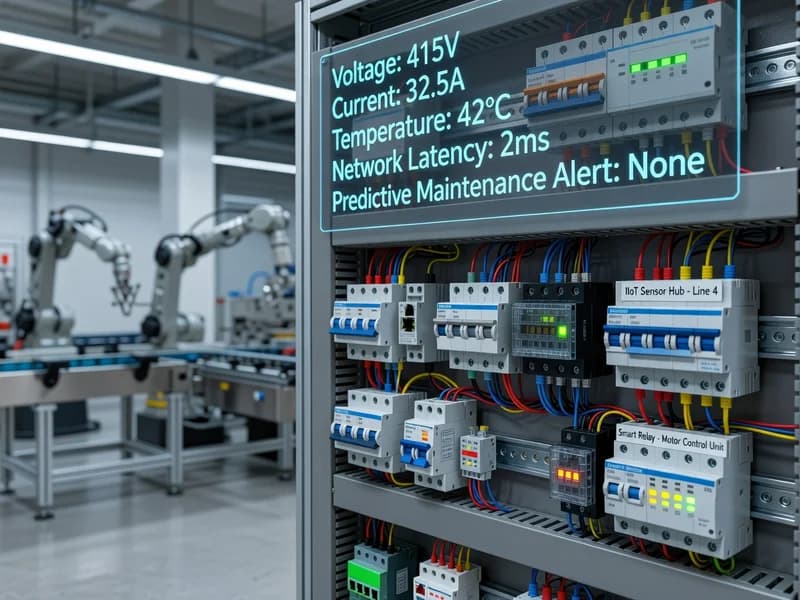
Industry 4.0 is changing industrial power and control systems by connecting electrical components to data networks, analytics platforms, and automation software. The Industrial Internet of Things (IIoT) brings sensing, communications, and edge computing into devices that used to be “silent” hardware—motor starters, contactors, circuit breakers, power supplies, drives, switchgear, and even terminal blocks. For electrical engineers and technicians, this shift is practical: better uptime, faster troubleshooting, safer operation, and more predictable maintenance.
This post explains where IIoT is showing up in electrical components, how the underlying standards fit together, and what to consider when specifying, installing, and maintaining connected components on the plant floor.
Connected Electrical Components: What’s Changing on the Shop Floor
Traditional electrical components focus on protection, switching, and power conversion. In an IIoT-enabled system, those same functions remain—but components increasingly include:
- Embedded sensors (current, voltage, temperature, vibration, insulation condition)
- Digital communications (EtherNet/IP, PROFINET, Modbus TCP, IO-Link)
- Diagnostics and event logging (trip history, load profile, thermal margin, cycle counts)
- Parameterization and remote configuration (setpoints, protection curves, firmware updates)
Common examples in modern panels and MCCs
-
Smart motor protection and starters
- Electronic overload relays or motor management relays can provide phase loss/imbalance, ground fault indication (where supported), thermal model data, and estimated remaining life.
- Integration into PLC/DCS networks enables condition-based maintenance instead of time-based replacement.
-
Connected circuit protection
- Modern MCCBs/ACBs often support trip units with metering and communications.
- Typical available data: RMS current per phase, power factor, kW/kWh, harmonics (model-dependent), breaker health indicators, and trip cause.
-
Power quality and energy monitoring
- Revenue-grade metering may follow IEC 62053 (energy metering accuracy classes) and power quality measurement methods align with IEC 61000-4-30 (power quality measurement methods).
- Data supports energy management, load shedding strategies, and root cause analysis for nuisance trips.
-
Smart power supplies (24 VDC)
- Diagnostics for output current, voltage dips, temperature, and overload events.
- Selectivity modules and electronic circuit protection provide granular fault isolation versus a single upstream fuse.
Why it matters to technicians
Connected components reduce “meter-and-guess” time. Instead of arriving after a trip and searching for clues, technicians can view:
- Trip timestamps and trip type
- Load and thermal history leading up to the event
- Voltage quality events (sags/swells) correlated with stoppages
- Intermittent faults captured via high-speed sampling or event logs
IIoT Communication and Interoperability: Standards You’ll See in Real Projects
IIoT value depends on interoperability—getting reliable data from devices to controllers, SCADA, historians, and cloud services. The most common layers include field communication, information models, and cybersecurity requirements.
Field/device networks and component-level connectivity
- IO-Link (IEC 61131-9)
Point-to-point communication for sensors/actuators and increasingly for compact devices (e.g., smart hubs, monitoring modules). Useful when you want standardized parameterization and diagnostics without a full Ethernet node at each device. - Industrial Ethernet protocols
- PROFINET (widely used in discrete manufacturing)
- EtherNet/IP (common in North American plants)
- Modbus TCP (simple integration, broad compatibility)
- Serial legacy integration
- Modbus RTU remains common for power meters and older drives/breakers. Gateways can bridge RTU to TCP or OPC UA.
Information modeling and OT-to-IT integration
- OPC UA (IEC 62541)
A platform-independent standard for secure, structured data exchange. Increasingly used to expose device data to SCADA/MES and to normalize data from multi-vendor components. - IEC 61850 (substation automation)
Primarily for utility/substation environments, but concepts (data models, eventing) influence industrial power monitoring and high-reliability electrical systems.
Practical interoperability tips
- Prefer components that support:
- Standardized data access (OPC UA server or gateway compatibility)
- Documented device profiles (e.g., PROFINET GSDML, EDS files for EtherNet/IP)
- Time synchronization for event correlation (NTP/PTP where applicable)
- Plan IP addressing, VLANs, and network segmentation early—especially for MCC lineups and large switchboards.
Predictive Maintenance and Diagnostics: Turning Electrical Data Into Uptime
IIoT enables a shift from reactive maintenance to predictive and condition-based approaches. The key is selecting signals that correlate to failure modes and acting on them with clear thresholds.
High-value measurements for electrical components
For motors and feeders
- Phase currents and unbalance (%)
- Start counts, run hours, thermal capacity used
- Ground fault/earth leakage (if sensors and protection support it)
- Contact wear indicators for contactors (where available)
For switchgear and connections
- Temperature monitoring at critical points (bus joints, cable lugs)
- Partial discharge monitoring (more common in MV systems)
- Humidity/condensation sensors in enclosures
For power quality
- Voltage sags/swells, interruptions
- Harmonic distortion (THD), especially with VFD-heavy loads
Measurement methods and immunity should align with the EMC framework of the IEC 61000 series (e.g., industrial immunity expectations), and device performance should be suitable for the electrical environment.
How predictive workflows look in practice
A practical IIoT maintenance workflow often includes:
- Baseline capture after commissioning (normal current, temperature rise, PQ metrics)
- Alarm thresholds tied to real limits (e.g., thermal margin, abnormal unbalance)
- Event correlation (breaker trip + upstream sag + simultaneous line restart)
- Work order automation (SCADA/CMMS integration)
Common “quick wins” that don’t require deep AI:
- Alarm on sustained current increase at constant load → mechanical binding or bearing issues
- Alarm on rising connection temperature at stable current → loose lug or corrosion
- Trend breaker operations and trip causes → nuisance trip reduction and coordination review
Design and Retrofit Considerations: What Engineers Should Specify
Adding IIoT isn’t only about buying “smart” parts—it’s a system design exercise involving power, network architecture, cybersecurity, and lifecycle management.
Component selection checklist (engineering-focused)
When specifying connected electrical components, confirm:
- Electrical ratings and compliance
- Switchgear, breakers, and controlgear should follow applicable IEC or UL product standards for your region (e.g., IEC 60947 series for low-voltage switchgear and controlgear is widely referenced globally).
- Data availability
- What parameters are exposed (RMS, demand, PQ, temperature)?
- What is the sampling rate and event capture capability?
- Integration method
- Native industrial Ethernet vs. IO-Link vs. gateway-based integration
- Environmental and enclosure requirements
- Temperature rise, ingress protection (IP rating), vibration, and industrial EMC robustness
- Firmware and lifecycle
- Update process, backward compatibility, spare parts strategy, and vendor support horizon
Cybersecurity and segmentation (do not skip this)
IIoT expands the attack surface. Use recognized guidance and enforce basic controls:
- IEC 62443 (industrial automation and control system security)
Useful for security zones/conduits, risk assessment, and supplier requirements. - Practical controls:
- Segment OT networks (VLANs/zones) and restrict traffic between zones
- Use role-based access and strong authentication for configuration tools
- Maintain an asset inventory including firmware versions
- Disable unused services/ports on gateways and managed switches
Retrofit pathways that minimize downtime
Many plants can get meaningful IIoT benefits without replacing entire lineups:
- Add power meters and breakers with communication trip units during planned shutdowns
- Use current transformers (CTs) and temperature sensors with remote I/O
- Deploy edge gateways that poll Modbus RTU devices and publish via OPC UA/MQTT to higher layers
- Start with one critical line or MCC section, prove ROI, then scale
Conclusion
IIoT is transforming electrical components from passive hardware into data-producing assets that support better reliability, safety, and energy performance. For engineers and technicians, the biggest gains come from practical diagnostics (trip cause, thermal loading, power quality events), standardized connectivity (IEC 61131-9 IO-Link, IEC 62541 OPC UA), and secure system design aligned with IEC 62443 principles. Whether you’re designing a new smart MCC or retrofitting a legacy plant, focusing on interoperable communications, actionable measurements, and maintainable cybersecurity will deliver Industry 4.0 benefits without compromising the fundamentals of electrical safety and protection.