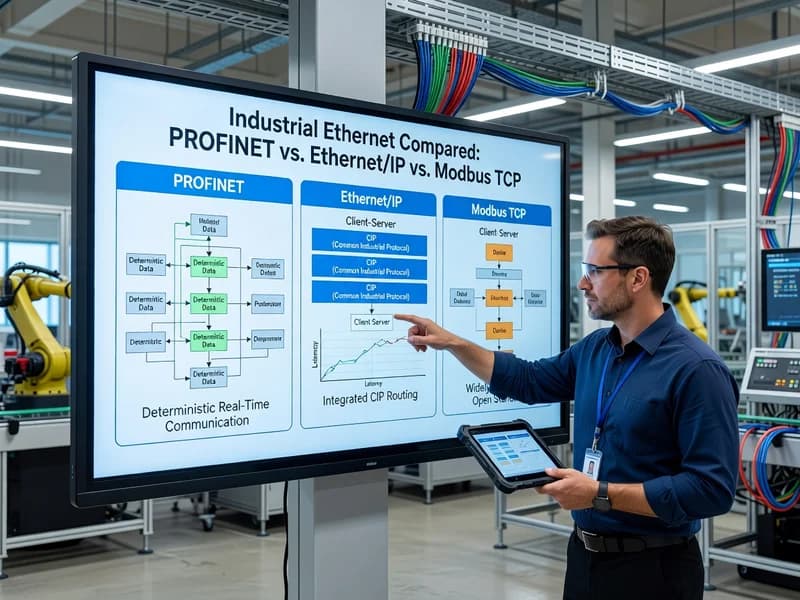
PROFINET vs EtherNet/IP vs Modbus TCP: Industrial Ethernet Compared
Introduction
Industrial Ethernet is no longer a “nice to have”—it’s the default networking layer for PLCs, remote I/O, drives, HMIs, vision systems, safety controllers, and increasingly for IIoT gateways. Among the most common choices are PROFINET, EtherNet/IP, and Modbus TCP. All three run on standard IEEE 802.3 Ethernet physical layers, but they differ significantly in real-time behavior, topology options, device interoperability, diagnostics, and how data is modeled.
This guide compares PROFINET vs EtherNet/IP vs Modbus TCP from a practical engineering perspective, with references to the standards bodies behind each technology, so you can make better choices when specifying industrial switches, PLCs, I/O blocks, connectors, and network accessories.
1) Standards, governance, and what “Industrial Ethernet” actually means
Although these protocols ride on Ethernet, they are not interchangeable. Each has its own specification, conformance testing, and device profiles.
PROFINET (PI / IEC)
- Governed by PROFIBUS & PROFINET International (PI).
- Standardized in the IEC 61158 / IEC 61784 family (industrial communication networks and profiles).
- Uses multiple communication classes:
- PROFINET RT (Real Time): cyclic I/O with prioritization at Layer 2.
- PROFINET IRT (Isochronous Real Time): high determinism using scheduled traffic and specialized hardware support (used in high-performance motion).
- Engineering and device integration relies on GSDML device descriptions (XML-based).
EtherNet/IP (ODVA / CIP)
- Governed by ODVA (Open DeviceNet Vendors Association).
- Uses the Common Industrial Protocol (CIP) over standard Ethernet:
- CIP over TCP/UDP/IP; cyclic I/O commonly uses UDP.
- Standardized via the same IEC families as industrial profiles (IEC 61784 profile sets include CIP-based profiles).
- Device integration via EDS (Electronic Data Sheet) and CIP objects (identity, assembly, connection manager, etc.).
Modbus TCP (Schneider-origin / Modbus Organization)
- Governed by the Modbus Organization.
- Specification: Modbus Application Protocol Specification and Modbus Messaging on TCP/IP Implementation Guide.
- Simple client/server (historically master/slave) model on TCP port 502.
- Not a “profile ecosystem” in the same way—many vendors implement it, but interoperability is largely about register mapping and documentation quality.
Practical takeaway: If you want broad multi-vendor device profiles for drives, safety, energy, and advanced diagnostics, PROFINET and EtherNet/IP offer deeper ecosystems. If you want a universally understood “lowest common denominator” protocol for data acquisition and basic control, Modbus TCP often wins on simplicity.
2) Real-time performance, determinism, and motion capability
When engineers ask “Which is faster?”, the more useful question is: Which provides deterministic update behavior at the jitter your application can tolerate?
PROFINET: RT and IRT options
- PROFINET RT achieves cyclic I/O by prioritizing frames (Layer 2) and minimizing TCP/IP overhead for real-time channels.
- PROFINET IRT adds time scheduling for very low jitter and precise synchronization—commonly selected for coordinated motion and high-end servo systems.
- PROFINET also supports synchronization mechanisms aligned with IEEE 1588 Precision Time Protocol (PTP) concepts for time alignment (implementation specifics depend on conformance class and device support).
Best fit:
- High-performance motion (especially with IRT-capable controllers and switches)
- Applications where jitter and cycle time consistency are critical
- Plants needing strong device diagnostics integrated into engineering tools
EtherNet/IP: CIP I/O connections and time sync
- Cyclic I/O is handled via CIP implicit messaging, typically over UDP, with configured RPI (Requested Packet Interval).
- For time synchronization, EtherNet/IP ecosystems often use CIP Sync and IEEE 1588 PTP-based approaches depending on device class and requirement.
- Determinism can be very good on well-designed networks, but performance depends heavily on topology, switch configuration, and traffic management.
Best fit:
- Discrete and process automation with robust vendor support (especially in Rockwell-centric environments)
- Systems benefiting from CIP object model consistency across devices
Modbus TCP: reliable, not deterministic by design
- Modbus TCP uses TCP. That’s good for reliable delivery, but it’s not designed for bounded latency or synchronized cyclic control.
- Poll/response behavior and TCP stack dynamics can introduce variable timing.
- Works well for supervisory-level reads/writes, parameterization, and simple control where tight deterministic loops aren’t required.
Best fit:
- SCADA data collection, basic PLC-to-device integration
- Energy meters, VFD parameter access, temperature controllers, valve manifolds (when hard real-time isn’t needed)
Rule of thumb:
- Coordinated motion / tight cyclic I/O → PROFINET (RT/IRT) or EtherNet/IP with well-engineered I/O scheduling
- Simple register-based integration → Modbus TCP
3) Data models and messaging: how each protocol “thinks”
A major difference is how each protocol represents data and services.
PROFINET: cyclic I/O plus rich device diagnostics
- Cyclic data exchange is mapped as input/output data areas configured in the controller.
- Devices expose standardized diagnostics and alarms; engineering tools can display faults like:
- Module missing
- Channel short-circuit
- Overtemperature
- Wire break (for analog)
- Strong integration with device profiles and PNIO conformance testing.
EtherNet/IP: CIP objects and explicit/implicit messaging
- Implicit messaging = real-time I/O connections (producer/consumer).
- Explicit messaging = acyclic reads/writes and services (configuration, diagnostics) via CIP objects.
- The CIP object model enables consistent access patterns across vendors (Identity Object, Parameter Object, etc.), which can simplify software and commissioning.
Modbus TCP: registers and function codes
- Everything is a register map:
- Coils (0xxxx), Discrete Inputs (1xxxx)
- Input Registers (3xxxx), Holding Registers (4xxxx)
- Uses function codes (e.g., 03 Read Holding Registers, 06 Write Single Register, 16 Write Multiple Registers).
- Interoperability depends on:
- Accurate register documentation
- Endianness conventions (32-bit values, floats)
- Scaling (engineering units) and update rates
Practical commissioning note: Modbus TCP integration time is often dominated not by networking, but by register map interpretation, scaling, and handling of 32-bit/float values.
4) Network design and components: switches, cabling, and diagnostics
Because these protocols share Ethernet hardware, many components overlap—but feature requirements differ.
Topologies and media
All three commonly use:
- Copper: 100BASE-TX (Cat5e/Cat6), 1000BASE-T
- Fiber: 100BASE-FX, 1000BASE-SX/LX depending on switch and transceivers
However:
- PROFINET installations often favor line/ring machine networks with managed switches and device-level diagnostics.
- EtherNet/IP networks are frequently deployed in star or ring topologies with managed switches and VLAN/QoS planning.
- Modbus TCP is commonly used over existing plant Ethernet, sometimes sharing networks with IT traffic (not always recommended for control).
Managed switch features that matter
For PROFINET and EtherNet/IP, managed industrial switches can materially improve reliability:
- QoS / 802.1p prioritization (helps cyclic traffic behavior)
- IGMP Snooping (important where multicast is used—commonly relevant in EtherNet/IP producer/consumer patterns)
- VLANs (802.1Q) to segment traffic
- Ring redundancy (vendor-specific or standards-based redundancy mechanisms, depending on architecture)
- Port mirroring for troubleshooting with Wireshark
- Industrial environmental ratings, redundant power inputs, and DIN-rail mounting
Diagnostics and maintenance reality
- PROFINET typically provides excellent out-of-the-box diagnostics in engineering tools, down to module/channel level (when supported by devices).
- EtherNet/IP diagnostics can be strong via CIP objects and vendor tools, but may require more protocol-specific familiarity.
- Modbus TCP troubleshooting is usually straightforward at the packet level, but device-level meaning is only as good as the register documentation.
Component selection tip for electrical teams:
Choose connectors, patch cords, and industrial switches rated for the environment (temperature, vibration, ingress). Many “network problems” are actually shield termination issues, ground potential differences, or marginal connectors—especially in VFD-heavy panels.
Conclusion
PROFINET, EtherNet/IP, and Modbus TCP all leverage Ethernet—but they serve different priorities:
- PROFINET excels when you need industrial-grade cyclic I/O, deep diagnostics, and (with IRT) high determinism for demanding applications. It’s strongly defined through PI conformance and IEC industrial network profiles.
- EtherNet/IP is a powerhouse in CIP-centric ecosystems, combining efficient cyclic I/O (implicit messaging) with a robust object model for configuration and diagnostics—well suited to large control architectures with many device types.
- Modbus TCP remains the practical, widely supported choice for simple integration and data access, especially where deterministic timing and rich device profiles aren’t required.
When specifying industrial electrical components for your next build—PLCs, remote I/O, managed switches, connectors, and cabling—start by defining cycle time and jitter tolerance, diagnostics expectations, vendor ecosystem, and network segmentation strategy. The “best” protocol is the one that meets those requirements with the least commissioning risk and the strongest long-term maintainability.