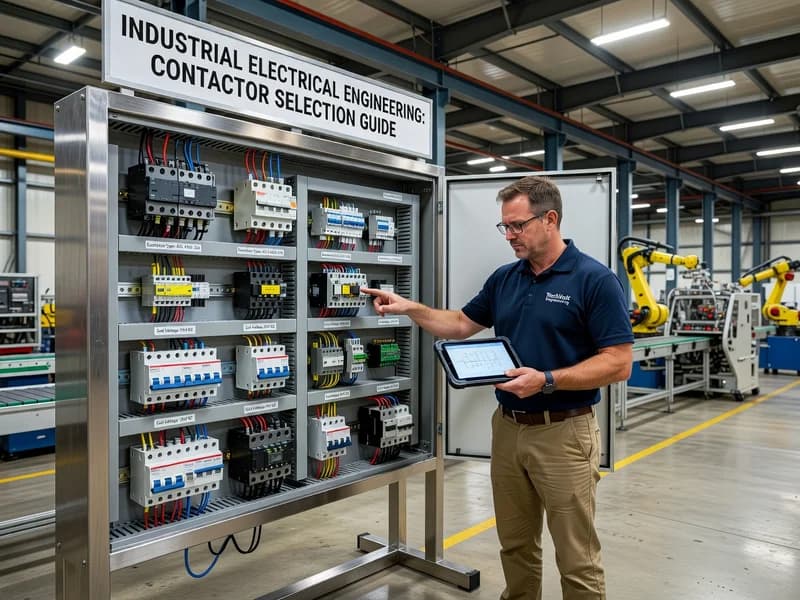
Complete Guide to Industrial Contactor Selection
Introduction
Selecting the right industrial contactor is critical for reliable motor control, heating loads, capacitor banks, and general-purpose switching. An undersized or misapplied contactor can cause nuisance trips, welded contacts, overheating, excessive downtime, or even safety incidents. This guide walks through a practical, standards-based approach to industrial contactor selection—focused on what electrical engineers and technicians need in the field: load type, utilization category, sizing, coil control, coordination with protection devices, and installation considerations.
1) Define the application: load type, duty, and utilization category
A “contactor” is not a one-size-fits-all switch. The first step is to classify what you are switching and how often.
Identify the load
Common industrial loads include:
- AC induction motors (across-the-line, reversing, jogging/inching)
- Resistive heating (furnaces, heaters)
- Capacitor banks (power factor correction)
- Transformers (inrush-dominated)
- Mixed loads (e.g., motor + heater)
Key parameters to document:
- System voltage and frequency (e.g., 400/480 V, 50/60 Hz)
- Load current (FLA for motors, steady current for heaters)
- Starting/inrush characteristics (LRA, inrush multiples, duration)
- Number of operations per hour and expected electrical/mechanical life
- Switching duty: normal switching, inching/jogging, plugging, etc.
- Environmental conditions: ambient temperature, altitude, enclosure/IP rating, contamination
Use IEC utilization categories (real-world essential)
Most industrial contactors are rated per IEC 60947-4-1 (Low-voltage switchgear and controlgear—Contactors and motor-starters). Utilization categories reflect how severe the switching duty is:
- AC-1: non-inductive or slightly inductive loads (resistive heating). Least demanding.
- AC-3: squirrel-cage motors—start/stop during running; contactor closes on inrush and opens at motor FLA. Common for across-the-line starters.
- AC-4: inching/jogging, plugging, reversing—opening at high current and often at elevated voltage. Much more demanding; requires higher rating or specialized contactor.
Practical note: A contactor that can handle a motor at AC-3 may need significant upsizing for AC-4. If your application includes frequent jogging or reversing, treat it as AC-4 unless the manufacturer explicitly provides duty tables for your cycle.
North American ratings (NEMA) vs IEC ratings
In North America you’ll also encounter NEMA ICS 2 “size” contactors. NEMA contactors are generally more conservatively rated and may tolerate broader applications without fine-grained utilization categories, but they can be physically larger. IEC contactors provide more application-specific ratings (AC-1/AC-3/AC-4), which is ideal when you can match the duty accurately.
2) Size the contactor: current, power, thermal limits, and derating
Once you know the load category, size based on manufacturer ratings under the correct utilization category, not just “amps on the label.”
Motor applications (IEC approach)
For AC motors under IEC, selection typically follows:
- Choose system voltage (e.g., 400 V or 690 V).
- Use the manufacturer table for AC-3 motor kW/HP rating at that voltage, or the AC-3 current (Ie).
- Validate against motor FLA and service conditions.
Important concepts from IEC 60947:
- Ie: rated operational current for the given utilization category.
- Ue: rated operational voltage.
- Ith: conventional free-air thermal current (important for heat rise, enclosure mounting, and continuous duty).
- Making/breaking capacity: must be adequate for inrush and switching.
If the contactor is installed in a warm enclosure or at high altitude, apply manufacturer derating. Many contactors are rated at 40 °C ambient; operation at 50–60 °C often requires downsizing the permitted current or upsizing the contactor.
Resistive heating loads (AC-1)
For heaters (AC-1), selection is usually straightforward:
- Size contactor by continuous current and thermal rating (Ith/Ie AC-1).
- Consider duty cycle and enclosure temperature rise.
Heating applications can be deceptively demanding if there are frequent cycles. Always check electrical life at your switching rate.
Capacitor switching (special case)
Capacitor banks produce high inrush currents and high di/dt. Many manufacturers offer capacitor-duty contactors with pre-charge resistors or early-make auxiliary contacts. Use:
- IEC guidance for capacitors (often referenced alongside IEC 60947 application data)
- Manufacturer’s maximum permissible inrush and kvar tables
- Appropriate reactors or inrush limiting where required
Avoid using a general-purpose AC-1/AC-3 contactor for capacitor banks unless explicitly rated.
Quick sizing checklist
- Match utilization category (AC-1/AC-3/AC-4).
- Verify Ue meets/exceeds system voltage.
- Ensure Ie (for your category) ≥ expected load current.
- Confirm Ith for continuous heating in your enclosure.
- Apply temperature/altitude derating.
- Check electrical life at your operations/hour.
3) Choose the coil and control interface: voltage, inrush, and suppression
The coil/control side is a frequent source of field issues: chatter, dropout, PLC output failures, and EMI.
Coil voltage and tolerance
Select coil type based on control power availability:
- AC coils: common in traditional control panels (e.g., 120 VAC, 230 VAC).
- DC coils: common with PLC/automation (e.g., 24 VDC).
Check coil pickup/dropout tolerances. IEC devices are commonly designed to operate across a control voltage range, but exact limits are manufacturer-specific. Undervoltage can cause chatter (contact bounce/overheating). Overvoltage increases coil heating and reduces life.
Inrush current and PLC outputs
Contactor coils have inrush—especially AC coils and some DC coils. When driven from PLC transistor outputs or safety relays:
- Confirm the output can handle inrush VA/W and steady-state coil draw.
- Consider using an interposing relay if margins are small.
Surge suppression (protect electronics and reduce EMI)
Coil suppression improves EMC and protects semiconductor outputs:
- DC coil: flyback diode (fast, but increases release time), or TVS diode for faster release.
- AC coil: RC snubber or MOV.
Coordinate suppression with safety requirements: in some safety circuits you may need faster drop-out times; choose suppression accordingly and verify stop category requirements.
Auxiliary contacts and interlocks
Specify auxiliaries based on the control scheme:
- 1NO + 1NC (typical for seal-in and feedback)
- Mirror contacts or positively guided contacts may be needed for safety feedback (verify per applicable safety standards and device documentation).
For reversing starters or mechanically interlocked contactors, use mechanical interlocks and proper electrical interlocking logic.
4) Coordinate with protection and verify short-circuit performance (SCCR)
A contactor must survive faults long enough for the protective device to clear the fault. This is where many panels fail compliance or experience catastrophic damage.
IEC coordination types (IEC 60947-4-1)
IEC defines coordination with short-circuit protective devices (SCPD), typically fuses or circuit breakers:
- Type 1 coordination: damage allowed; must not endanger personnel; may require repair/replacement.
- Type 2 coordination: no damage requiring replacement; minor contact welding allowed if easily separated.
If uptime matters, aim for Type 2 using manufacturer-tested combinations.
SCCR (North America) and UL considerations
For industrial control panels built to UL 508A, the assembly requires a Short-Circuit Current Rating (SCCR). Contactor selection impacts SCCR because:
- Components must have adequate short-circuit ratings.
- SCCR can depend on tested combinations (e.g., contactor + specific fuse class or breaker).
If your market requires UL/CSA compliance, select contactors that are UL Listed/Recognized as appropriate and use manufacturer coordination tables to support SCCR documentation.
Overload protection for motors
A contactor is not overload protection. Motor circuits typically require:
- Overload relay (thermal or electronic) matched to motor FLA and service factor
- Short-circuit protection (fuse/breaker) per local code and design standards
In IEC motor starters, overload relays are commonly paired and directly mounted to the contactor, simplifying selection and coordination.
5) Practical installation considerations: enclosure, wiring, and lifecycle
Even a correctly sized contactor can fail prematurely if installed poorly.
Enclosure and heat
- Verify ambient inside enclosure, not just room temperature.
- Respect spacing requirements for heat dissipation.
- Consider IP-rated enclosures or contamination protection as needed.
Terminal and conductor considerations
- Confirm terminal type supports your conductor (ring/fork, ferrules, lug size).
- Use manufacturer torque specs; loose terminals cause heat and failures.
- For high vibration environments, consider spring clamp terminals if available.
Maintenance, wear indicators, and spares
- Track electrical life and switching frequency; schedule preventive replacement for high-duty applications.
- Consider contactors with mechanical indicators or condition monitoring auxiliaries where downtime is costly.
- Standardize on a few frame sizes and coil voltages to simplify spares.
Conclusion
Industrial contactor selection is best approached as an application-matching exercise grounded in real ratings and standards—not just a current number. Start by identifying the load and duty cycle, then choose the correct utilization category (IEC 60947-4-1), size using manufacturer data with derating for enclosure conditions, and select a coil/control strategy that won’t stress PLC outputs or create EMI issues. Finally, validate coordination with protective devices—Type 1/Type 2 under IEC and SCCR/UL 508A requirements where applicable—so the system performs safely during faults. Done correctly, the right contactor improves reliability, reduces downtime, and extends the life of the entire motor control or switching system.