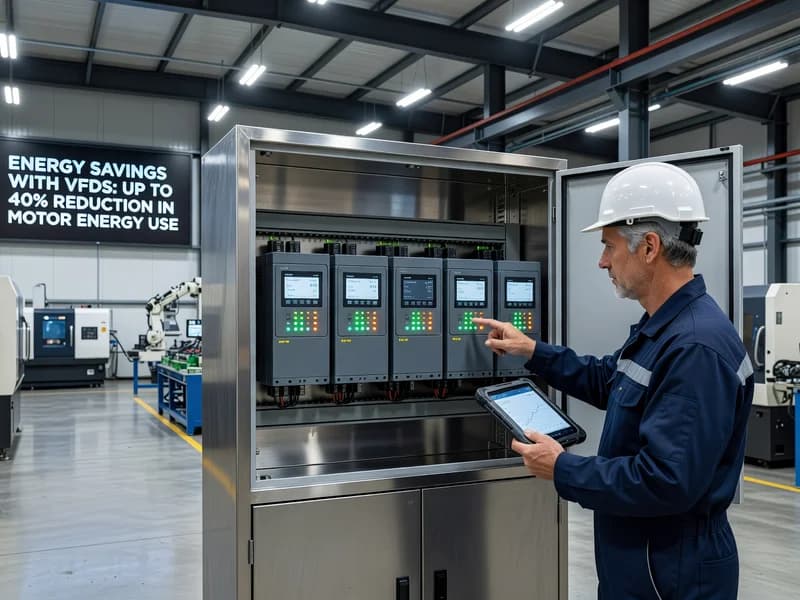
How Variable Frequency Drives Save Energy in Industrial Plants
Introduction
Variable Frequency Drives (VFDs)—also called adjustable speed drives (ASDs)—are one of the most effective ways to reduce electrical energy consumption in industrial plants. By controlling motor speed and torque to match process demand, VFDs can dramatically cut wasted energy in variable-torque loads like fans and pumps, while also improving process control and reducing mechanical stress.
This post explains how VFDs save energy, where the savings come from, what to watch for in real installations, and which standards and specifications matter when selecting and applying drives in industrial environments.
How VFDs Reduce Energy Use: The Physics and the Electrical Fundamentals
The core energy-saving mechanism is simple: many processes don’t need full speed all the time. Traditional control methods (throttling valves, dampers, bypass lines) keep the motor at constant speed and intentionally add loss to reduce flow. A VFD instead reduces motor speed, which reduces the work the system performs.
The affinity laws (fans and pumps)
For centrifugal fans and pumps, the affinity laws describe how flow, head/pressure, and power change with speed:
- Flow: ( Q \propto N )
- Head/pressure: ( H \propto N^2 )
- Power: ( P \propto N^3 )
Where (N) is rotational speed.
Practical implication: a modest speed reduction yields a large power reduction. For example, reducing speed to 80%:
- (P \approx 0.8^3 = 0.512) → about 49% power reduction
This is why VFDs are especially impactful on:
- Cooling tower fans
- HVAC supply/return fans
- Chilled water and condenser water pumps
- Process water circulation pumps
What a VFD is doing electrically
Most industrial VFDs are AC drives with:
- Rectifier (AC to DC)
- DC bus (energy storage/filtering)
- Inverter (DC to variable-frequency, variable-voltage AC using PWM)
By varying output frequency, the drive controls motor speed. By maintaining an appropriate volts-per-hertz (V/Hz) ratio (or using vector control), the drive maintains torque capability while avoiding over-fluxing the motor.
Where VFD Energy Savings Show Up in Real Plants
Energy savings are highest when the load profile is variable and the process runs many hours per year. In constant-torque applications (conveyors, positive displacement pumps), savings can still occur but are typically smaller and depend on duty cycle and control strategy.
Common “before vs. after” scenarios
1) Throttled pump with control valve
- Before: pump runs at 60 Hz; valve throttles flow; excess head is dissipated as heat and pressure loss.
- After: VFD reduces speed to maintain flow/pressure setpoint; valve can remain more open; system operates closer to best efficiency.
2) Fan with inlet vane damper
- Before: fan at full speed; damper adds restriction.
- After: VFD reduces speed to meet static pressure requirement; damper becomes a safety/trim device.
3) Multiple pumps/fans (staging) VFDs can enable:
- Lead/lag control with speed trimming
- Maintaining a stable header pressure with fewer starts/stops
- Optimized staging (one variable-speed + several fixed-speed)
An engineering method to estimate savings
A practical approach for centrifugal loads:
- Determine the percentage of time at various flow/speed points.
- Use the affinity law (P \propto N^3) to estimate relative power at each point.
- Compare to baseline power (constant speed with throttling).
- Multiply by operating hours and energy cost.
Also consider system curve changes—e.g., fouling, filter loading, seasonal conditions—because real operating points shift. Logging kW and speed via the VFD (or plant historian) is often the most reliable way to validate savings.
Additional operational savings (not just kWh)
VFDs often reduce secondary costs that aren’t captured in a simple energy calculation:
- Reduced mechanical wear: softer acceleration/deceleration reduces coupling, belt, and bearing stress.
- Lower peak demand: avoiding across-the-line starting reduces demand spikes.
- Improved control: tighter pressure/flow control can reduce scrap, rework, and process instability.
Selection and Application Best Practices (What Engineers and Techs Should Verify)
VFD projects succeed when the drive is matched to the motor, the load, and the power system—and when installation details (wiring, grounding, filtering, cooling) are handled correctly.
Match the drive to the load type and torque needs
Key application questions:
- Is the load variable torque (fans/pumps) or constant torque (conveyors, extruders)?
- What is the speed range required?
- Are there high-inertia loads requiring higher overload capability?
- Is closed-loop control needed (pressure transducer, flowmeter, encoder feedback)?
Common control modes:
- V/Hz: simple, robust; often sufficient for fans/pumps.
- Sensorless vector: better torque at low speed.
- Flux vector with encoder: highest performance for demanding torque/speed regulation.
Verify motor suitability and insulation stress
PWM inverters create fast voltage rise times (high dv/dt) that can stress motor insulation, especially with long motor leads. Practical checks:
- Cable length and routing
- Need for dv/dt filter or sine filter
- Motor insulation rating suitability (commonly “inverter-duty” motors for severe applications)
While motor insulation specifics vary by manufacturer, many engineers reference guidance aligned with NEMA MG 1 (notably Part 31 for inverter-fed motors) for insulation capability and application considerations.
Address harmonics and power quality
VFD rectifiers draw non-sinusoidal current, producing harmonics that can affect transformers, generators, and plant power quality.
Key standards/specifications:
- IEEE 519: recommended practice and requirements for harmonic control in electric power systems (often used as the benchmark at the point of common coupling).
- IEC 61800-3: EMC requirements and test methods for adjustable speed electrical power drive systems.
- IEC 61800-5-1: safety requirements for adjustable speed drive systems.
Mitigation options (selected based on plant constraints and targets):
- Line reactors (AC chokes): reduce current distortion and protect drive.
- DC link chokes: improve harmonic performance.
- Passive harmonic filters: tuned or broadband.
- Active harmonic filters: dynamic compensation for varying loads.
- 12-pulse/18-pulse front ends: transformer-based harmonic reduction.
- Active front end (AFE): can reduce harmonics and allow regeneration in some designs.
Grounding, shielding, and EMI control
VFD installations can create electromagnetic interference and bearing currents if grounding is poor. Good practices include:
- Use symmetrical, shielded motor cable where recommended by the drive manufacturer.
- Terminate shields properly (360° bonding where applicable).
- Ensure a low-impedance equipment grounding path.
- Consider common-mode chokes, insulated bearings, or shaft grounding rings for large motors or sensitive setups.
Compliance and workmanship guidance is often aligned with NFPA 70 (NEC) for wiring methods and safety in the US, and relevant IEC/local codes elsewhere.
Consider braking and regeneration opportunities
Even when the main goal is energy savings, some applications can recover energy:
- Centrifuges
- Downhill conveyors
- High-inertia overhauling loads
- Test stands
Options include:
- Dynamic braking resistor (dissipates energy as heat)
- Regenerative/AFE drive (returns energy to the supply)
Regeneration isn’t common for fans/pumps, but it can be significant in cyclic or overhauling systems.
Commissioning and Verification: Turning “Expected” Savings into Measured Results
Energy projects should include a verification plan so savings are defensible and repeatable.
Commissioning checklist (practical)
- Confirm motor nameplate data is correctly entered (voltage, FLA, base frequency, RPM).
- Auto-tune (if applicable) and verify direction of rotation.
- Validate process feedback scaling (pressure/flow transmitters).
- Set acceleration/deceleration ramps to avoid nuisance trips and water hammer.
- Configure minimum speed limits to ensure adequate cooling and process constraints.
- Confirm bypass/hand-off-auto modes operate safely.
- Trend and review:
- kW and kWh
- speed command/actual
- process variable (pressure/flow)
- alarms and trips
For formal energy verification, many plants use approaches consistent with IPMVP (International Performance Measurement and Verification Protocol), selecting a method appropriate to the project complexity.
Conclusion
VFDs save energy in industrial plants by matching motor speed to real process demand—eliminating the inefficiencies of throttling and damping, especially in centrifugal fan and pump systems where power scales roughly with the cube of speed. Beyond kWh reduction, VFDs often deliver better process stability, lower mechanical stress, and reduced demand peaks.
To capture these benefits reliably, engineers and technicians should apply VFDs with attention to load characteristics, motor insulation and cabling, harmonics (commonly evaluated against IEEE 519), and EMC/safety requirements (IEC 61800 series), then verify results through commissioning data and ongoing trending. With proper design and implementation, VFD retrofits and new installations are among the fastest, most repeatable energy-saving upgrades available in modern industrial facilities.