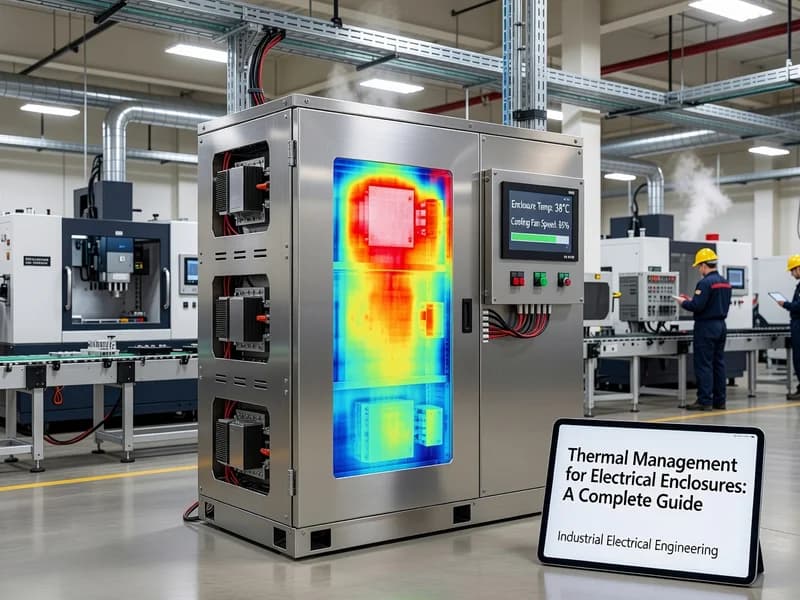
Thermal Management for Electrical Enclosures: A Complete Guide
Introduction
Thermal management is one of the most common (and most overlooked) causes of electrical enclosure failures. Excess heat accelerates insulation aging, derates power electronics, increases nuisance trips, and can push components outside their listed operating limits. In industrial environments—where ambient temperatures, dust, moisture, and washdown conditions are common—choosing the right cooling (or heating) strategy is as important as selecting the enclosure itself.
This guide explains how to estimate heat load, choose practical thermal management methods, and verify compliance using widely recognized standards such as IEC 61439 (low-voltage switchgear and controlgear assemblies), IEC 60529 (IP rating), IEC 60068-2 (environmental tests), and UL 508A (industrial control panels). It’s written for electrical engineers and technicians specifying or maintaining control panels, MCC buckets, VFD cabinets, and instrument enclosures.
Section 1: Why enclosure temperature matters (and what “acceptable” means)
Most industrial components are rated for an ambient temperature range—commonly 0–40 °C for standard equipment, with extended ratings available (e.g., 50 °C or 55 °C). Enclosure internal air temperature often runs well above ambient due to internal losses and solar/nearby process heat.
Key impacts of high temperature include:
- Reduced reliability: Many electronic components follow an Arrhenius-type relationship; a common rule of thumb is that every 10 °C increase can significantly reduce life expectancy (exact factor depends on component).
- Derating and performance limits: VFDs, power supplies, PLC I/O, and breakers may require current/thermal derating above certain temperatures.
- Insulation aging: Higher temperature accelerates insulation degradation and can reduce long-term dielectric strength.
- Condensation risk (the other side of the coin): Overcooling below dew point can create condensation that leads to corrosion and tracking.
Practical targets:
- Design to keep enclosure internal air at or below the lowest component allowable ambient (often 40 °C unless specified otherwise).
- Consider that standards like IEC 61439 require thermal verification of assemblies; acceptable temperature rise depends on conductor insulation class, terminals, and device ratings. Manufacturers often provide temperature rise limits or allowable internal ambient.
Section 2: Estimating the heat load (a practical workflow)
Before selecting fans, filters, AC units, or heat exchangers, calculate the heat that must be removed. In steady state, internal heat generation roughly equals heat that must be dissipated to maintain the desired temperature.
Step 1: Identify internal heat sources (Watts)
Typical contributors:
- VFDs / servo drives: Often 2–5% of output power as losses (check datasheet efficiency).
- Power supplies: Losses = output power × (1/efficiency − 1).
- Transformers: No-load (core) loss + load (copper) loss.
- Contactors/relays: Coil power and contact losses (small but can add up).
- Breakers/busbars: I²R losses at high currents.
Use manufacturer data wherever possible. If not available, start with conservative estimates and refine later.
Step 2: Determine ambient conditions and allowable internal temperature
Collect:
- Maximum ambient outside the enclosure (e.g., 35 °C in plant, 50 °C near furnace, rooftop solar loading, etc.)
- Desired maximum internal temperature (e.g., 40 °C)
- Enclosure location factors: direct sun, proximity to hot equipment, ventilation restrictions.
Step 3: Consider ingress protection and environment constraints
Your thermal solution must maintain the required enclosure rating:
- IP rating per IEC 60529 (e.g., IP54, IP66)
- NEMA type (commonly used in North America—NEMA 12, 4, 4X, etc.)
This step often eliminates “simple fan” solutions for dusty, oily, or washdown environments unless you use properly rated filtered ventilation kits.
Step 4: Quick sizing concepts (rules of thumb)
While detailed sizing is best done with manufacturer selection tools, these concepts help validate choices:
- Natural convection is limited and depends heavily on enclosure surface area and ΔT (temperature difference). It’s often insufficient for high-density drives.
- Forced ventilation increases convective heat transfer, but brings in ambient air (and contaminants).
- Closed-loop cooling (air-to-air or air-to-water heat exchangers; AC units) isolates internal air and supports higher IP/NEMA ratings.
Practical note: When internal heat loads exceed a few hundred watts in a compact enclosure, natural convection is rarely enough—especially with high ambient.
Section 3: Choosing the right thermal management method (pros, cons, and best uses)
1) Passive cooling (no fans, no AC)
Includes:
- Heat dissipation through enclosure walls
- Heat sinks / mounting plates designed to spread heat
- Radiative cooling (paint color, emissivity) and avoiding solar load
Best for:
- Low heat loads
- Clean environments or very high ingress protection needs
- Remote sites where maintenance is difficult
Limitations:
- Often requires higher allowable internal temperatures or larger enclosures
- Performance drops when ambient approaches allowable internal temperature
Tip: Simply upsizing the enclosure can lower temperature rise by increasing surface area and improving internal airflow paths.
2) Forced ventilation (fans + filters, louvers)
This method exchanges internal air with ambient air.
Best for:
- Moderate heat loads
- Environments where dust/oil can be managed with filtration
- Applications where enclosure rating allows it (often NEMA 12 / IP54 with appropriate kits)
Design considerations:
- Use filtered intake low and exhaust high (supports chimney effect).
- Maintain slight positive pressure when possible to reduce ingress.
- Select filters by particle size and service interval; clogged filters are a common failure mode.
- Ensure fan performance at operating static pressure (filters add pressure drop).
Maintenance reality: Filters must be inspected and replaced. If the plant cannot support routine filter maintenance, consider closed-loop methods.
3) Closed-loop air-to-air heat exchangers
These circulate internal air through a heat exchanger, transferring heat to outside air without mixing the air streams.
Best for:
- Dusty environments, oily mist, or where you must maintain a higher IP/NEMA rating
- Moderate to high heat loads, depending on exchanger capacity
- Sites where you can tolerate dependence on outside air temperature (they cannot cool below ambient)
Notes:
- Still requires external air path; keep external fins clean.
- Avoid mounting where external airflow is blocked.
4) Air conditioners (closed-loop refrigeration)
Panel AC units can maintain internal temperature below ambient, which is crucial in hot facilities.
Best for:
- High ambient temperatures
- High heat loads and dense power electronics
- When internal temperature must be tightly controlled
Key points:
- Verify electrical supply and inrush current.
- Ensure condensate management (drain or evaporative design).
- Maintain seals to preserve NEMA 4/4X or equivalent where required.
5) Air-to-water heat exchangers (facility cooling water)
These remove heat using plant chilled water or process water.
Best for:
- Very high heat loads
- Locations where rejecting heat to room air is undesirable
- Plants with reliable chilled water systems
Cautions:
- Water quality and corrosion control
- Leak risk and shutoff/alarms
- Condensation risk if the cold plate drops below dew point
6) Enclosure heaters (yes, heating is thermal management)
In cold or humid environments, heaters prevent condensation and maintain minimum operating temperature.
Best for:
- Outdoor enclosures
- Coastal/high-humidity installations
- Applications with frequent temperature cycling
Control options:
- Thermostats, hygrostats, or combined temperature/humidity controllers
Section 4: Implementation best practices (layout, verification, and compliance)
Panel layout and airflow
Good thermal design starts with physical arrangement:
- Separate high-loss devices (drives, braking resistors, power supplies) from temperature-sensitive PLCs and analog I/O.
- Keep vertical airflow paths clear; avoid wiring duct blocking exhaust zones.
- Use internal circulation fans (even in closed-loop designs) to eliminate hot spots.
- Mount heat-generating devices per manufacturer spacing guidelines to prevent localized overheating.
Instrumentation and verification testing
Don’t rely solely on calculations—verify with measurements:
- Place temperature sensors at:
- Top of enclosure (hot air region)
- Near critical components (VFD heatsink inlet, PLC area)
- Near cable terminations/busbars for high-current assemblies
- Use infrared scans to detect hotspots, but confirm with contact/air probes where needed.
- For assemblies under IEC 61439, thermal verification can be done by:
- Testing, or
- Comparison with a reference design, or
- Calculation methods permitted by the standard (as applicable)
Environmental and ingress considerations:
- Confirm the final design maintains required IP rating (IEC 60529) or NEMA type.
- Consider environmental testing concepts from IEC 60068-2 series (temperature cycling, damp heat) when reliability is critical.
North American control panel considerations (UL 508A)
If you build or modify industrial control panels for the North American market:
- UL 508A governs industrial control panels and includes requirements for component selection, wiring methods, and ratings.
- Thermal considerations often tie back to:
- Component temperature ratings
- Wire insulation temperature ratings
- Spacing and installation instructions that affect heating
Always follow manufacturer installation instructions—these are often part of the conditions of acceptability for listed/recognized components.
Common mistakes to avoid
- Undersizing cooling because “it worked in another plant” (ambient and duty cycle matter).
- Placing the enclosure in direct sunlight without solar load mitigation.
- Using filtered fans in environments where filters clog quickly (leading to overheating).
- Overcooling without humidity control, causing condensation.
- Ignoring service access—thermal systems need cleaning and inspection.
Conclusion
Effective thermal management for electrical enclosures is a balance of heat-load estimation, environmental constraints, enclosure rating requirements, and maintainability. Start by quantifying internal losses in watts, define worst-case ambient conditions, and choose a strategy—passive, ventilated, closed-loop heat exchange, AC, water cooling, or heaters—that maintains component limits while preserving the required IP (IEC 60529) or NEMA protection. For assemblies governed by IEC 61439 and panels built to UL 508A, treat thermal performance as a compliance and reliability issue, not just a comfort margin.
A well-designed enclosure thermal solution reduces downtime, extends component life, and keeps your control system operating within its intended specifications—year after year.